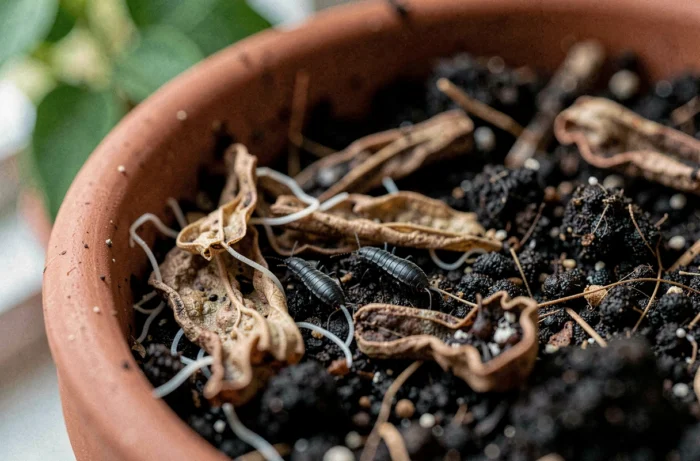
Springtails measure between 0.5 and 6 mm depending on the species. They are not insects in the strict sense, but wingless apterous hexapods that propel themselves using a folded abdominal organ called furca. Their presence in a dwelling almost always indicates a persistent excess of humidity, not a parasitic infestation.
Furca and movement: understanding the jump of springtails
The characteristic jump of these little black creatures comes from a precise mechanism. The furca, a kind of forked appendage located under the abdomen, is kept under tension by a ventral hook called a retinacle. When the animal is disturbed, the retinacle releases the furca, which strikes the ground and propels the springtail several centimeters.
This rapid leap is often confused with that of a flea. The difference is clear: the flea has long, muscular hind legs adapted for active jumping. The springtail, on the other hand, uses only its furca. If the creature you observe jumps erratically, almost like a marble being thrown, you are likely dealing with a springtail.
To spot springtails and other jumping black creatures, observe the damp areas of the dwelling: around the bathtub, tile joints, under plant pots, shower traps. Their elongated or globular bodies, often white, gray, or black, make them difficult to photograph without magnification.
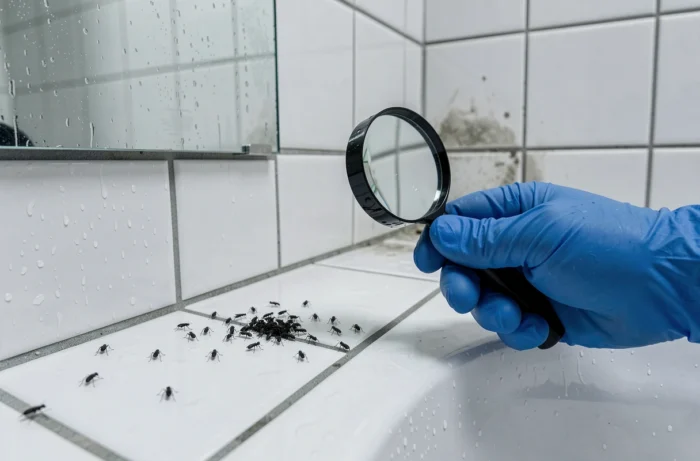
Humidity threshold and proliferation: why springtails appear in your home
Springtails do not settle by chance. Their presence is directly linked to the indoor humidity level. Beyond 60% relative humidity continuously, conditions become favorable for their development. Once it reaches 70 to 80% in a poorly ventilated room, proliferation accelerates significantly.
In practical terms, this points to specific causes:
- A hidden water leak behind a vanity, under a shower tray, or in a concealed pipe that maintains a permanent moldy substrate.
- A faulty or absent mechanical ventilation system, common in older homes where ventilation is limited to a passive grille obstructed by dust.
- An excess of watering indoor plants, whose waterlogged soil becomes an ideal habitat for colonies of several hundred individuals.
- Chronic condensation on windows and joints, especially in bathrooms or kitchens, which creates micro-wet zones invisible in daily life.
Measuring humidity with a simple hygrometer (available for a few euros) allows for a quick check to see if the dwelling is in this risk zone. Without correcting the humidity, any chemical intervention remains temporary: springtails return as soon as conditions become favorable again.
Springtail or flea: concrete distinguishing criteria
The confusion between springtails and fleas is common, but the consequences are not the same. The flea bites, feeds on blood, and requires pest control treatment. The springtail does not bite and feeds on microscopic fungi, decomposing organic matter, and soil microorganisms.
Three visual criteria to decide
First, size: springtails rarely exceed 2 mm indoors, while the cat flea reaches 2 to 3 mm with a laterally flattened body, clearly visible to the naked eye. Next, shape: the springtail has a rounded or elongated body, never compressed on the sides. Finally, location: fleas concentrate on textiles (carpets, bedding, pet cushions), while springtails remain confined to damp surfaces.
If you find red bites lined up on your ankles or calves, lean towards the flea or bedbug. The complete absence of bites, combined with the location near water, confirms the springtail.
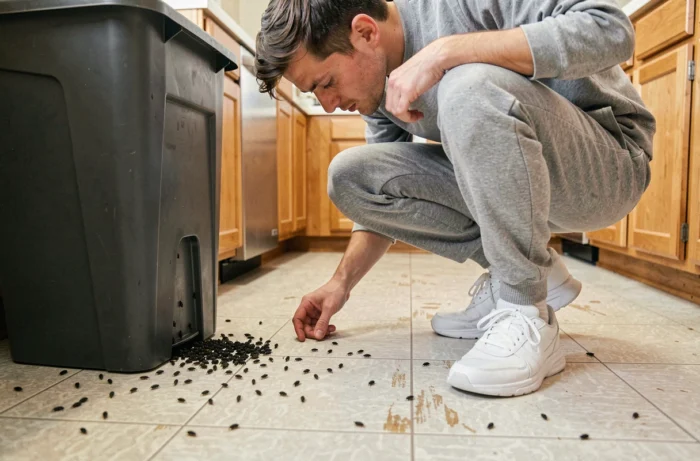
Getting rid of springtails without chemical treatment
The only sustainable lever is reducing humidity. This approach is now recommended by building and pest control professionals, who find that insecticide treatments on springtails produce ephemeral results if the environment remains humid.
Priority actions on ventilation and leaks
Check the operation of your mechanical ventilation system by placing a sheet of paper in front of the extraction vent: if it does not stick, the airflow is insufficient. Clean the filters and vents, or replace the motor if necessary. In rooms without mechanical ventilation, daily airing for ten to fifteen minutes, with the window wide open, significantly lowers humidity.
Look for invisible leaks. A detached bathtub seal, a poorly connected trap, or a micro-crack in a concealed PER pipe is enough to maintain a permanent moisture source. Repairing these points eliminates the food and habitat source for springtails within a few weeks.
Indoor plant soil
Reduce the frequency of watering and allow the top layer of soil to dry out between waterings. Repotting with a draining substrate (perlite-soil mix) limits surface water retention. In cases of heavy colonization, temporarily moving the pots outside accelerates the natural dispersion of springtails to the garden soil, where they resume their useful role as decomposers.
An electric dehumidifier can complement these measures in structurally humid rooms (basements, ground floors on slabs). The goal is to maintain humidity below 60% consistently. Springtails naturally disappear from a dry environment, without the need for any products.