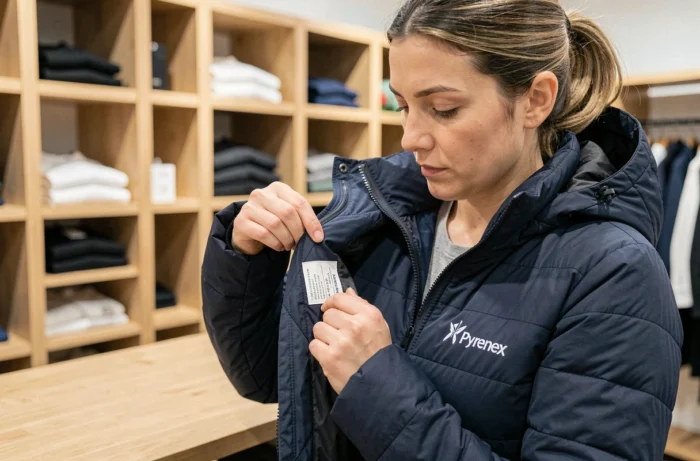
The filling of a Pyrenex down jacket is based on gray duck down from the Landes region, selected for its loftiness and thermal capacity. This technical starting point conditions everything else: a counterfeit Pyrenex almost always betrays its origin by the quality of the filling even before looking at a label.
Pyrenex Down and Filling: The Tactile Test That Counterfeits Fail
We consistently observe the same flaw in copies: a filling that is too rigid, which does not regain its shape after compression. Authentic Pyrenex down has a high loft characteristic of the gray duck from Landes. Squeeze a compartment between your fingers, release. The original down re-inflates in a few seconds, evenly.
On a counterfeit, the filling remains flattened or shows irregular areas. Some copies use polyester mixed with crushed feathers, resulting in a grainy feel instead of the characteristic softness. Weight is another indicator: for the same volume, the real Pyrenex down jacket remains light compared to the warmth provided. A copy weighs significantly more for less insulation.
This tactile test also works with smell. Quality down that has been treated properly does not emit any animal odor, even in humid weather. Counterfeit fillings, washed and treated under approximate conditions, often release a rancid smell at the first rains.
To know how to recognize an authentic Pyrenex beyond the feel, we recommend cross-referencing this tactile evaluation with the examination of the detailed construction elements below.
Pyrenex Zippers and Seams: The Construction Details That Differentiate
Zippers are a reliable but misunderstood marker. Pyrenex uses YKK zippers engraved on the slider and pull tab. The engraving is clear, raised, never painted. On a copy, the YKK marking may exist (forgers sometimes buy low-end YKK batches), but the smoothness of the mechanism differs.
Test the opening and closing several times in a row. On an authentic model, the slider glides without snagging or resistance, even at the bottom of the run. A counterfeit zipper gets stuck, skips, or has slight lateral play.
Seams and Compartment Stitching
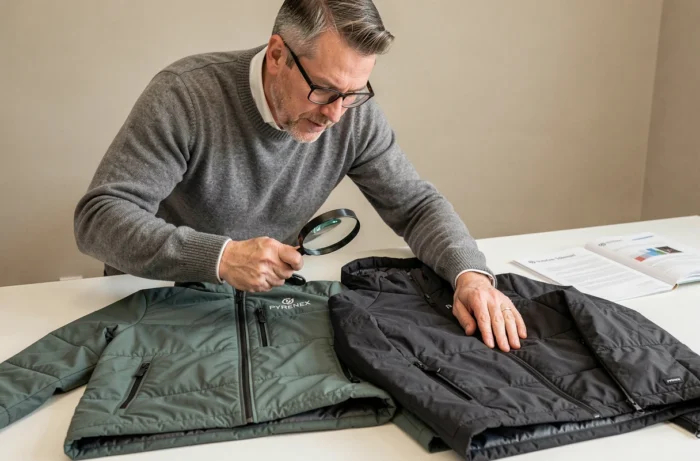
The stitching of the down compartments deserves special attention. On an authentic Pyrenex, the seams are straight with a regular stitch length. We recommend turning the down jacket inside out and examining the internal seams in the light:
- The internal topstitching should be clean, with no loose threads or visible knots. A thread sticking out by several millimeters indicates sloppy assembly
- The junctions between compartments have a fabric reinforcement on authentic models, absent on most copies
- The finishing bias around the collar and cuffs is sewn flat, never wrinkled or peeling
These checks take less than a minute and eliminate the majority of gross counterfeits.
Composition Label and Pyrenex Traceability: Technical Reading
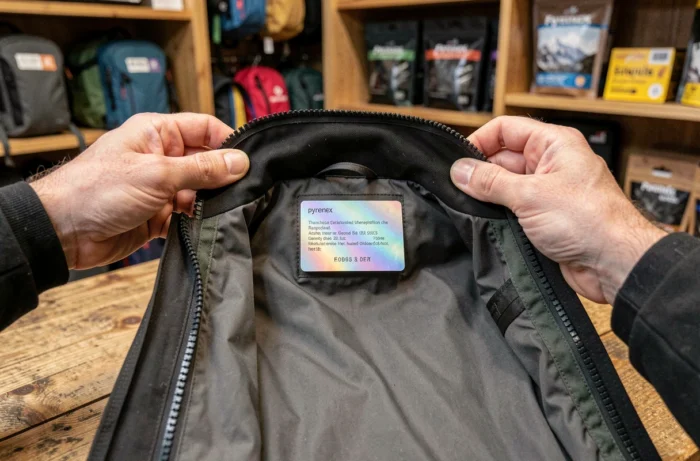
The inner label of a Pyrenex down jacket contains several standardized pieces of information. The composition of the filling is expressed as a percentage of down/feathers, in accordance with European textile regulations. The country of manufacture is also indicated.
A often overlooked point: Pyrenex does not manufacture all its pieces in France. Some models are assembled outside the territory, which is mentioned on the label. A counterfeit sometimes displays “Made in France” on a model whose authentic production is outsourced, which paradoxically constitutes a sign of a fake.
Serial Number and Digital Passport
Recent models include a digital traceability system linked to the serial number. This code, sewn onto a separate label, can be verified with the brand. Forgeries sometimes copy existing numbers taken from authentic models photographed in stores. Therefore, checking the number is not enough: this data must be cross-referenced with the model, size, and color.
A valid number associated with a model that does not exist in that color or size immediately betrays the counterfeit.
Distribution Circuit and Pyrenex Customs Intervention Request
Purchasing outside the authorized network remains the primary risk factor. Pyrenex distributes its products through its own stores, its official website, and a network of selected retailers. Any channel not referenced by the brand significantly increases the risk of counterfeiting.
On the institutional side, premium brands have an unknown lever: the customs intervention request. This free device, valid for one year and renewable, allows the brand holder to send customs a detailed sheet of the visual and technical characteristics of authentic products. Customs then relies on this profile to intercept suspicious flows at borders and in warehouses.
The national campaign “Menez l’enquête,” launched in the summer of 2026, raises consumer awareness about identifying counterfeit consumer goods, including branded clothing. This mobilization reflects increased monitoring of premium textile flows, with rising volumes of seizures and destructions in recent years.
Points of Caution on Resale Platforms
- A price lower than half the official retail price should trigger a reflex of distrust, even on a model presented as second-hand
- Generic photos (studio white background, identical angles) reused from one listing to another indicate a seller who does not physically possess the product
- Always request a photo of the inner label and serial number before any commitment
Textile counterfeiting has gained sophistication, but the combination of the tactile test on the filling, examination of zippers and seams, rigorous reading of the label, and verification of the distribution circuit remains the most reliable method to authenticate a Pyrenex down jacket. None of these criteria taken in isolation guarantees authenticity: it is their convergence that makes the distinction.