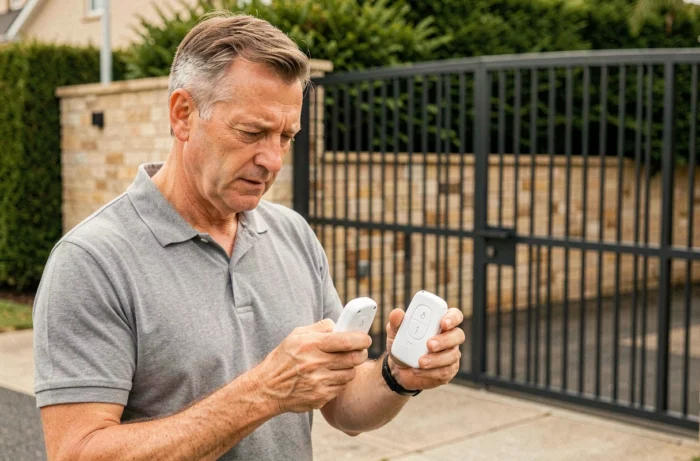
Synchronizing two gate remote controls involves copying the radio signal from an already programmed transmitter to a second transmitter, without going through the receiver attached to the motor. This operation relies on the compatibility of frequency and coding type between the two devices. If these parameters are incorrectly identified, the operation will fail on the first attempt.
Fixed code or rolling code: the parameter that determines the synchronization method
Before bringing the two remote controls close together, it’s necessary to determine the type of coding used by the motorization system. This point conditions everything that follows.
A fixed code transmitter sends the same radio sequence with each press. Copying to a second compatible remote control takes just a few seconds, through a simple signal transfer. Most universal remote controls sold online target this format.
A rolling code transmitter generates a new sequence with each use. The receiver and the remote control share an algorithm that synchronizes their codes. Copying this signal between two transmitters without intervention on the receiver is technically impossible for most brands (Somfy, FAAC, CAME). The procedure then requires physical access to the receiver’s housing to register the new transmitter.
To find out what coding your system uses, consult the receiver’s manual or the label attached to the back of the original remote control. The mention “rolling code,” “hopping code,” or a padlock pictogram indicates a rotating code. If in doubt, typing the model reference into a search engine will clarify the ambiguity in seconds.
Radio frequency and compatibility between gate remote controls
The emission frequency is the second criterion for compatibility. Gate and garage remote controls primarily operate on two bands: 433.92 MHz and 868 MHz. Two transmitters with different frequencies cannot synchronize, even if they use the same type of coding.
The frequency is indicated on the remote control’s label or in its technical sheet. It is also found on the receiver, near the antenna. If you buy a universal remote control, check that it covers the band of your installation. Some multi-frequency models exist, but their reliability varies by brand.
It is possible to program a gate remote control via La Bonne Maison to find the procedure suited to your configuration, especially when the original manual has disappeared.
Synchronizing two fixed code gate remote controls: the concrete procedure
With two compatible transmitters (same frequency, fixed code), the synchronization by self-learning follows a common pattern for most models. Here is the typical sequence:
- Place the two remote controls facing each other, a few centimeters apart, LED to LED if they have them.
- On the new remote control, press and hold the learning button (often identified by a symbol or located on the back) until the light flashes quickly.
- Simultaneously press the button on the original remote control corresponding to the desired function (full opening, pedestrian opening, etc.).
- Keep both buttons pressed until the light on the new remote control changes rhythm or turns off, confirming the signal copy.
- Test immediately in front of the gate to validate the operation.
If the light does not change behavior after about ten seconds, release and try again. A repeated failure often indicates a coding incompatibility, not a hardware defect.
Case of four-button remote controls
When the original transmitter has several buttons assigned to different functions (gate, garage, lighting), each button must be synchronized separately. Repeat the procedure for each channel by pressing the corresponding button on the source remote control, then on the target button of the new remote control.
Registering a remote control on the rolling code receiver
In rolling code, synchronization must go through the motorization receiver. Depending on the brands, two methods coexist.
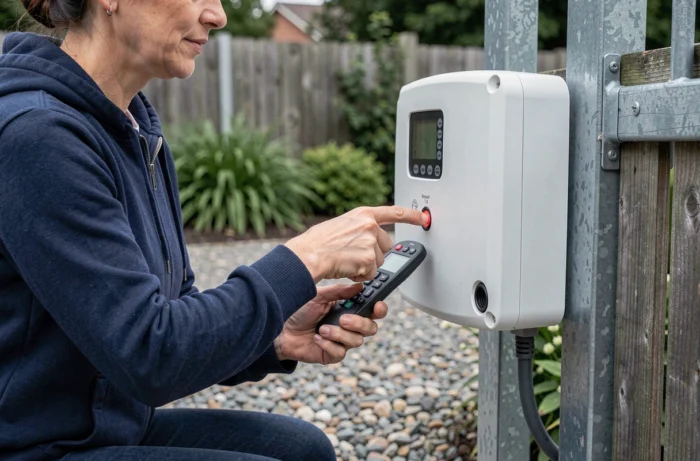
Learning via the receiver button is the most common. Open the motor cover to access the electronic board. Briefly press the “PROG,” “LEARN,” or “RF-Learn” button on the receiver. A light will turn on or blink to indicate the recording mode. Then press the desired button on the new remote control. The light confirms the memory by changing state.
The second method uses an already registered remote control as “master.” On some CAME or FAAC systems, a long press on a specific button of the master remote control activates the transfer mode. The new remote control is then presented to receive permission. This manipulation avoids opening the motor housing, but it is not available on all models.
Common problems after synchronization and technical causes
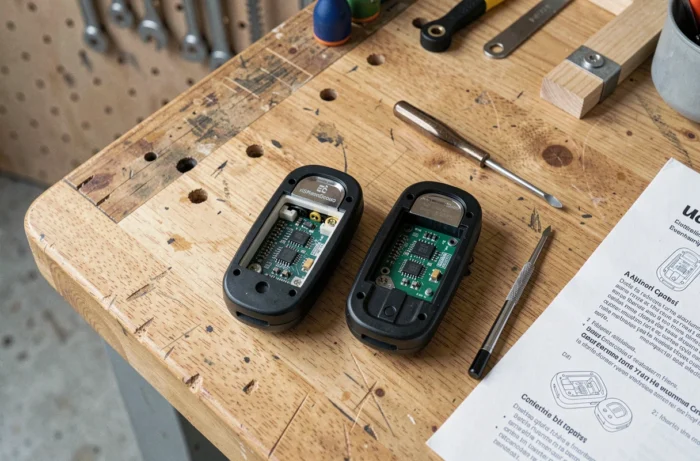
A freshly synchronized remote control that does not operate the gate can have several origins:
- The battery of the new remote control is weak. Even new, a battery stored for a long time loses voltage. Replace it before resuming the procedure.
- The distance between the two transmitters during copying was too great. A few centimeters are sufficient; beyond that, the signal is too weak to be properly captured.
- The receiver has reached its maximum capacity of stored remote controls. Most home receivers accept between ten and thirty transmitters. Delete old unused transmitters via the reset procedure described in the receiver’s manual.
ETSI EN 300 220-2 standard and future compatibility
Version 3.3.1 of the ETSI EN 300 220-2 standard, applicable to short-range radio devices (including remote controls at 433.92 MHz and 868 MHz), strengthens the performance requirements for receivers. Its implementation is expected by 2027. Remote controls and receivers marketed after this deadline will need to pass stricter frequency stability tests. Synchronizing a recent transmitter with an old receiver could then pose compatibility issues on some aging installations.
Keeping the receiver’s manual and noting the exact reference of each registered remote control remains the most useful reflex. The day a transmitter fails or needs to be replaced, this information saves considerable time compared to identification by trial and error.