
Managing the health of pets increasingly involves digital tools. Between veterinary appointment booking platforms, digital health records, and clinic management software, the offerings have expanded in recent years. Not all these online services cover the same needs. Comparing their features allows for choosing the tool that fits one’s situation.
Key features of online veterinary platforms: comparison table
Online veterinary services are divided into several categories based on their primary use. Some focus on appointment booking, others on managing the animal’s medical record, and some combine both with additional functions like product ordering or teleconsultation.
| Type of platform | Appointment Booking | Digital Health Record | Online Ordering (food, products) | Automatic Reminders (vaccines, treatments) | Teleconsultation |
|---|---|---|---|---|---|
| Specialized appointment booking (e.g., MonRendezVousVeto) | Yes | No | No | No | No |
| Health record app (e.g., Zoovet) | No | Yes | Click&Collect (partners) | Yes | No |
| Integrated clinic space (e.g., Mon Espace Véto) | Variable | Yes | Yes (packages, food) | Yes | No |
| Veterinary telemedicine platform | No | No | No | No | Yes |
This table highlights a frequently underestimated point: no platform covers all needs. An owner wanting to book an appointment, check their dog’s vaccination record, and order specific food will, in most cases, have to juggle between two or three different tools.
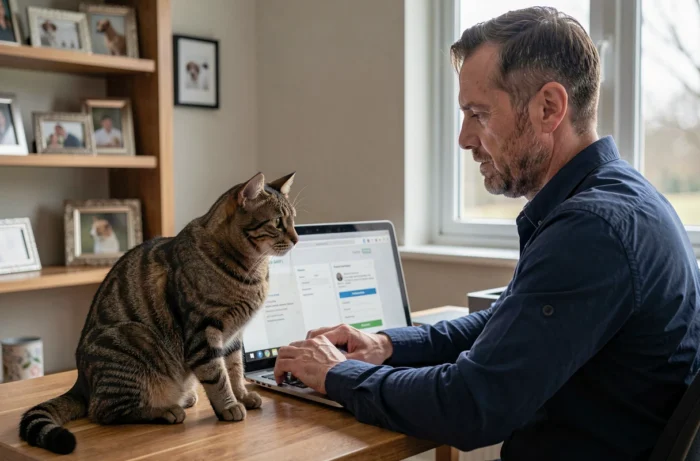
To access Espace Animaux online, simply log in from a browser or mobile device, which consolidates several veterinary resources into one entry point.
Veterinary management software and client space: two distinct accesses
A common confusion concerns the difference between the management software used by the veterinary clinic and the client space accessible to the pet owner. These are two separate systems, even when they share a similar name.
Clinic side: management software
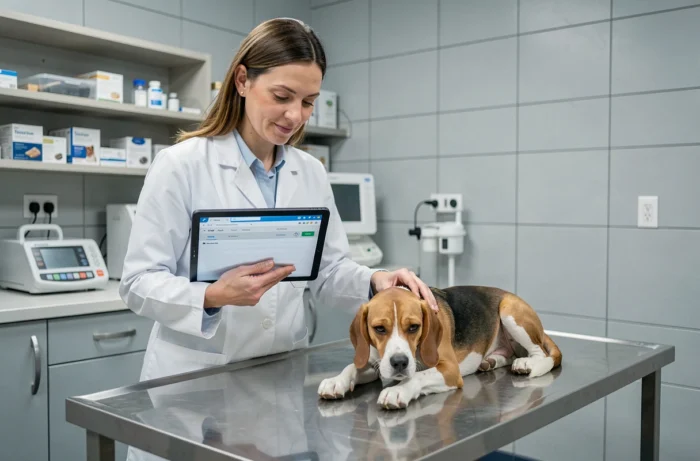
The management software of a veterinary clinic is used to organize consultations, store medical records, manage billing, and track medication inventory. The care team accesses it daily. This software is not open to the public.
The owner never has access to the clinic’s internal software. What they see is a simplified interface, a client space, which only displays information related to their own animals.
Owner side: online space
The client space generally allows for viewing visit history, checking upcoming vaccination reminders, and sometimes booking appointments. The richness of the information available directly depends on the software used by the clinic and its level of integration.
- Some clinics offer complete online access with treatment history, prescriptions, and test results.
- Others limit access to appointment booking without any medical data available remotely.
- Some platforms add the option to order veterinary products via click and collect, but only from partner clinics.
This disparity explains why two owners in the same city can have very different experiences depending on the clinic they visit.
Mobile app or veterinary website: selection criteria for managing pets
The access format, mobile app or website, is not a detail. It affects the frequency of use and the nature of the available functions.
Mobile apps like Zoovet rely on push notifications for health reminders. A reminder for deworming or vaccination appears directly on the phone screen, reducing forgetfulness. However, these apps require installation, regular updates, and storage space on the smartphone.
Websites accessible from a browser require no installation. They work on any connected device. A veterinary website remains accessible even when changing phones, without data transfer or reinstallation. The downside: no native push notifications, which means one must remember to log in.
Animal health data security
The information stored on these platforms includes the pet’s name, species, breed, medical history, and sometimes the owner’s contact details. The question of protecting this data arises.
The National Order of Veterinarians has implemented a veterinary authentication system online to ensure that professionals practicing online are indeed registered with the Order. This system allows owners to verify the veterinarian’s identity before any remote consultation.
Before creating an account on a veterinary platform, checking for clear legal mentions and a privacy policy remains a useful reflex. Platforms associated with recognized structures in France generally offer a more transparent framework.
Veterinary teleconsultation: what the format allows and what it excludes
Veterinary teleconsultation does not replace a physical examination. It allows for initial triage, post-operative follow-up, or behavioral advice, but a reliable diagnosis usually requires a clinical examination.
The regulatory framework mandates that teleconsultation be conducted by a veterinarian registered with the Order. The required equipment is limited to a stable internet connection and a device with a camera. The animal must be in a quiet place so that the veterinarian can observe its behavior.
- Teleconsultation works well for follow-up questions, feeding, or behavior.
- It is unsuitable for emergencies, acute pain, or suspected fractures.
- The veterinarian can refer to a physical consultation if the situation requires it.
This format remains complementary. It does not replace regular follow-ups at the clinic, particularly for vaccinations and annual health checks for dogs, cats, or any other pets.
The choice between these different tools depends on the number of animals to manage, the clinic frequented, and the desired level of follow-up. Combining a health record app with the online space of one’s clinic covers most common needs without multiplying unnecessary accounts.