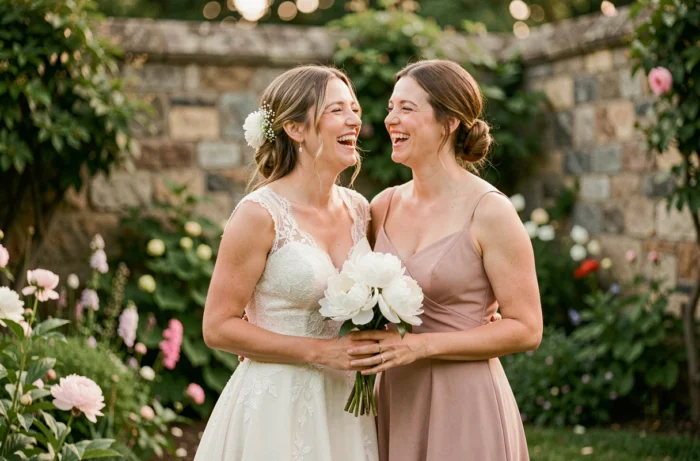
The term “maid” suggests that only single women can hold this role at a wedding. This linguistic confusion persists, even though no legal or religious rule in France conditions the function to the marital status of the chosen person. Let’s see what customs, etiquette, and current practices say to settle this question.
Maid of honor and matron of honor: a distinction of vocabulary, not of function
The Anglo-Saxon tradition, widely adopted in France in recent years, distinguishes two titles. The maid of honor refers to a single woman, while the matron of honor refers to a married woman. The responsibilities attached to each title are strictly identical.
This terminological nuance has never constituted a binding norm. It falls under social etiquette, not civil law or canon law. In practice, the majority of French brides and grooms are even unaware of this distinction and use the generic term “demoiselle d’honneur” regardless of the person’s status.
The recent trend goes even further: some couples abandon these titles in favor of neutral phrases like “honor witness” or “honor attendant,” which completely neutralizes the question of marital status. The role of maid of honor for a married woman therefore remains the same as for a single woman, from organizing the bachelorette party to the procession on the day of the ceremony.
Married or single maid of honor: a comparison of real differences
A table allows us to visualize what changes concretely according to the marital status of the maid of honor, and what does not change.
| Criterion | Single maid of honor | Married maid of honor |
|---|---|---|
| Traditional Anglo-Saxon title | Maid of honor | Matron of honor |
| Role and missions | Identical | Identical |
| Legal prohibition in France | None | None |
| Restriction in the Catholic rite | None | None |
| Restriction in the Protestant rite | None | None |
| Dress and accessories for the procession | Chosen by the bride | Chosen by the bride |
| Participation in the bachelorette party | Yes | Yes |
| Procession during the ceremony | Yes | Yes |
The reading of this table is clear: there is no functional difference between the two profiles. The only discrepancy concerns a title that most French-speaking weddings do not even use.
Why confusion persists around the marital status of maids of honor
The origin of this misunderstanding is twofold. The word “demoiselle” in French historically refers to an unmarried young woman. This linguistic connotation creates an automatic exclusion reflex towards women who are already engaged.
The second factor comes from American cinema. Romantic comedies feature processions of young single women, reinforcing the idea that the role is reserved for those who do not wear a ring. In reality, the American tradition itself provides for the title of matron of honor for married women, proof that exclusion has never been the rule, even across the Atlantic.
In France, the tradition of the procession of maids of honor is relatively recent. It has developed under Anglo-Saxon influence over the past two decades. This cultural adoption occurred without importing the maid/matron distinction, which explains the current ambiguity.
Bridesmaid and wedding witness: do not confuse the two roles
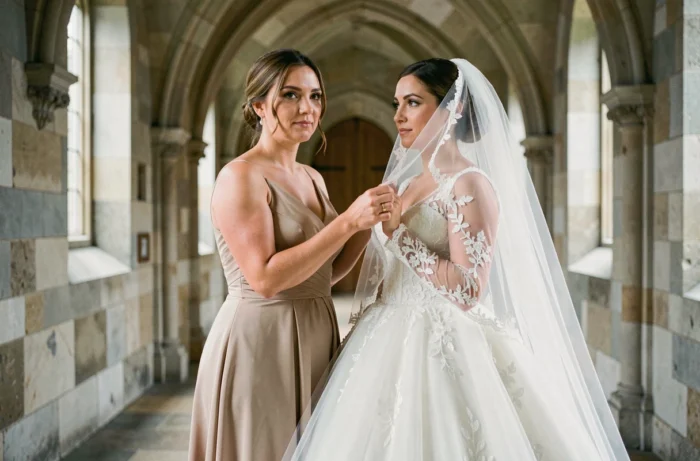
Another source of confusion deserves clarification. Under French law, wedding witnesses have a legal role: they sign the marriage certificate at the town hall. Their number is regulated (a minimum of two, a maximum of four). Their marital status is not a selection criterion.
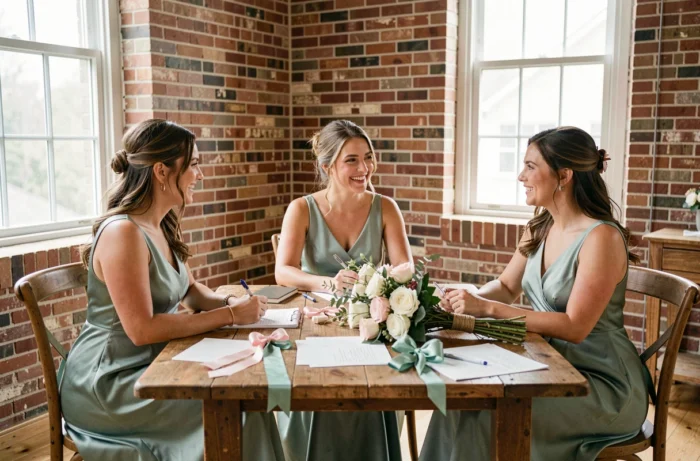
The maid of honor, on the other hand, has no legal status. Her role is purely ceremonial and organizational. Here are the main missions that fall to her:
- Assist the bride in choosing the dress and accessories for the procession, participating in fittings and scouting
- Organize or co-organize the bachelorette party, in coordination with other group members
- Accompany the bride on the big day for preparation, the procession, and managing logistical surprises
- Ensure the smooth running of the day by serving as a liaison between the bride, the service providers, and the guests
A married woman fulfills these missions with the same effectiveness as a single woman. Some wedding planners even highlight an advantage: a maid of honor who has already experienced her own wedding knows the stressful situations, the deadlines to anticipate, and the details that are easily forgotten.
Criteria for choosing a maid of honor: what really matters
Rather than marital status, three criteria determine the right choice:
- The emotional closeness to the bride: sister, close cousin, long-time friend. The bond of trust takes precedence over any other parameter
- Real availability over several months: between organizing the bachelorette party, dress fittings, and coordination on the big day, the role requires time
- The ability to handle pressure: a maid of honor manages surprises, calms tensions, and remains a reliable point of contact for the couple and the service providers
The number of maids of honor in the procession varies according to weddings. The most common configurations include between two and six people, with no imposed rule. Mixing single friends and married friends in the same procession poses no etiquette problem.
The marital status of a maid of honor does not change her missions, legitimacy, or the course of the ceremony. The only question that deserves to be asked at the time of selection concerns the trust relationship between the bride and the person she wishes to have by her side.