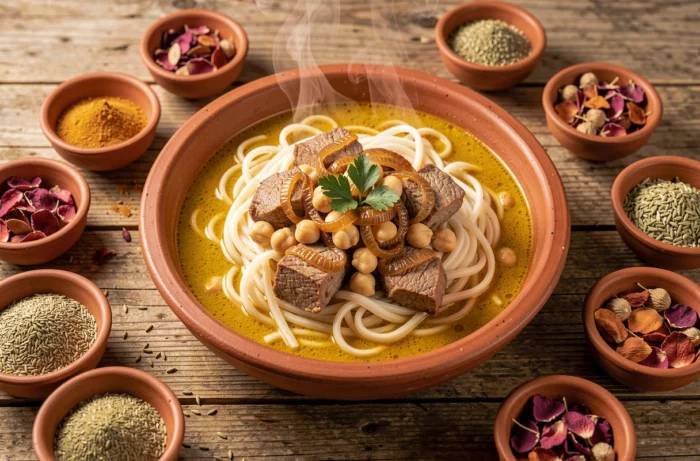
Tunisian rechta is not just a dish of pasta in sauce. It is a combination of precise gestures, from kneading the dough to the final plating, where each step influences the texture of the result. In Tunisia, the second largest consumer of pasta in the world per capita (behind Italy, according to La Presse de Tunisie), this type of preparation based on semolina occupies a central place in daily food.
Semolina and hydration: the choice that changes the texture of rechta
Have you ever noticed that two rechtas prepared with the same recipe can yield very different results? The main variable is the semolina. Fine durum wheat semolina produces a smooth dough that is easy to roll out. Medium semolina gives more grain and better adherence for the sauce.
Hydration is just as important as the choice of semolina. Warm water is added in small amounts, never all at once. The dough should be soft without sticking to the fingers. If it sticks, it has been over-hydrated. If it cracks while stretching, it has not been hydrated enough.
A concrete guideline: after kneading, let the dough rest covered for about twenty minutes. This resting time allows the gluten to relax. The rolling out then becomes even, without the dough retracting. Chefs who work with rechta daily emphasize this resting period, often overlooked by beginners eager to move on to cutting.
To delve deeper into this step and the following ones, Utile au Quotidien’s tips detail several technical points on preparing the dough.
Cutting and steaming rechta: two common mistakes
The cutting of the strips is the moment when rechta takes (or loses) its identity. If they are too thick, they remain doughy in the center. If they are too thin, they disintegrate in the sauce.
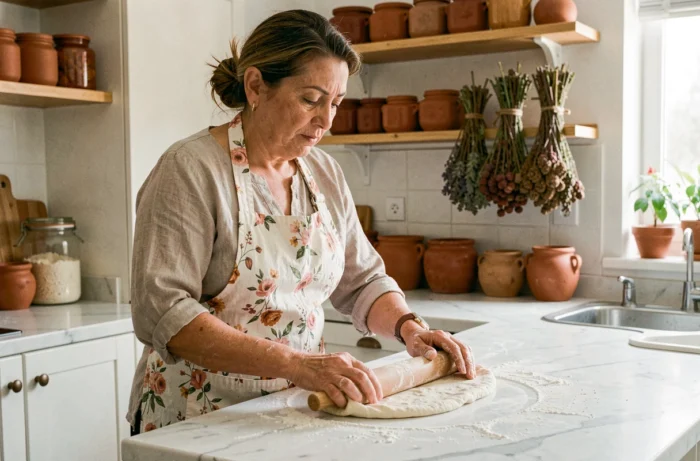
Why choose steaming over boiling in water? Because steam preserves the structure of fresh semolina pasta. When submerged in water, the strips absorb too much liquid and lose their firm texture. The couscoussier, placed above the simmering sauce pot, cooks the pasta in the fragrant steam of the broth.
Two mistakes often occur:
- Stacking the strips in a block in the couscoussier. They stick together and cook unevenly. They need to be aired out, separated by hand before placing them.
- Cooking too long. Fresh semolina pasta cooks quickly in steam, in just a few minutes. As soon as they become soft without being mushy, turn off the heat.
- Forgetting to seal the junction between the pot and the couscoussier. If steam escapes from the sides, cooking is uneven. A damp cloth wrapped around the junction solves the problem.
Meat tomato sauce: building flavor step by step
The sauce for Tunisian rechta is based on a simple principle: sauté the meat and onions before adding the tomato paste. This browning step develops aromas that are not present if everything is added at once.
Garlic, crushed in a mortar with tabel (a Tunisian spice mix), is added during simmering, not at the beginning. This late addition preserves the aromatic power of the garlic, which would dissipate if thrown into hot oil from the start.
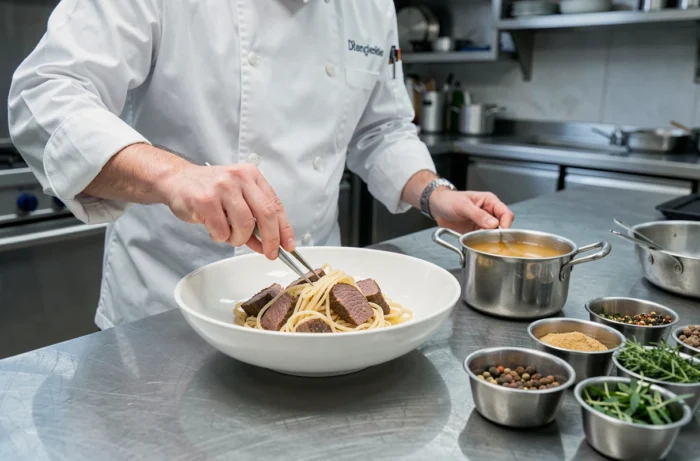
Turmeric gives the characteristic golden color. Chili powder adds heat. Bay leaves add a background note. The balance between tomato paste and water determines the final thickness of the sauce. Too much water results in a clear broth that does not coat the pasta. Not enough, and the sauce sticks to the bottom of the pot.
Vegetables (potatoes, carrots, peas) are added after the meat, when the sauce has already thickened. They finish cooking in the fragrant broth without diluting it.
Bizerte rechta: a regional variant to know
Not all Tunisian rechtas are alike. The Bizerte region has a particularly rich heritage of artisanal pasta. Rechta njara, literally “sawdust noodle” in reference to its very fine texture, is made exclusively by hand by specialized artisans.
According to Tunisian chef Foued Frini, quoted by Middle East Eye, Bizerte’s rechta njara dates back to the Persian era, long before the arrival of Andalusian traditions that enriched local cuisine. What distinguishes this variant is the extreme fineness of the strips, achieved through patient stretching that machines cannot replicate.
Bizerte also features other formats of artisanal pasta: makrounet dar, jat khemira, hlalem, nwasser, gritlya. Each format corresponds to a specific sauce and use. Rechta njara is traditionally paired with chicken and dried fruits, a combination different from the classic rechta with tomato sauce and red meat.
Plating and serving Tunisian rechta
Plating is not just a matter of presentation. Once the pasta is steamed, it is transferred to a large shallow dish and the sauce is poured over it. The gesture involves gently mixing so that each strip is coated, without crushing the pasta.
The meat and vegetables are placed on top, visible. This is not a dish to be stirred like spaghetti bolognese. Rechta is served generously, with enough sauce so that the bottom of the dish remains moist until the last bite.
In a country where pasta consumption per capita rivals that of Italy, rechta remains a strong culinary marker. Successfully preparing it requires less talent than rigor in three areas: well-hydrated and rested dough, mastered steaming, and a sauce built in successive layers of flavors. The rest follows naturally.