A cracked screen or a battery that fails in the middle of the day doesn’t leave much room for error. Smartphone repair by postal service or remote diagnostics has been structured around short turnaround times, but choosing an online service provider relies on technical criteria that most comparisons overlook.
Micro-soldering and motherboard repair: the real filter between online providers
The majority of remote repair services cover screen and battery replacement. These interventions are standardized, well-documented, and do not pose particular difficulties for a trained technician. The criterion that truly separates professional workshops from entry-level structures is the ability to perform micro-soldering on the motherboard.
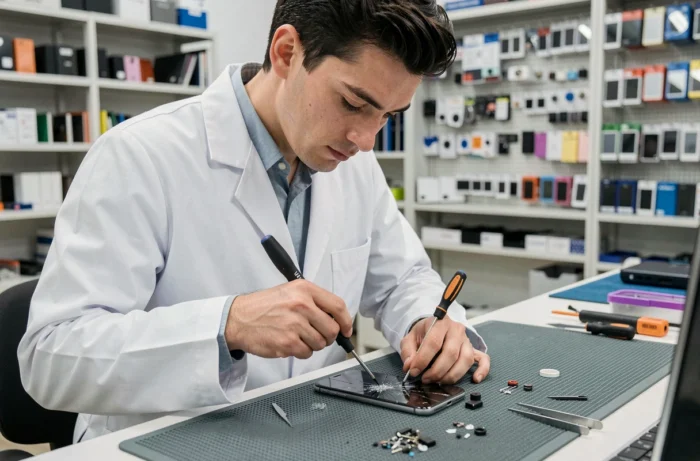
A smartphone with a faulty charging circuit, power controller, or baseband chip requires work under a binocular microscope with a hot air soldering station. Not all workshops have this equipment, and even fewer have qualified personnel to use it. Before sending a device, we recommend checking if the provider explicitly mentions motherboard repair in their pricing, as finding all the info on Mobile Junky allows you to compare the levels of intervention offered.
A workshop that limits itself to module replacements (screen, battery, charging connector) without offering micro-soldering will return the device unrepaired in the case of a complex failure, resulting in lost time and shipping costs at your expense.

QualiRépar bonus: amounts and conditions for smartphones in 2026
The QualiRépar scheme has expanded its scope since January 2024 to include smartphone screen damage. The standard bonus reaches 25 euros for a smartphone, deducted directly from the bill at a certified repairer, without any action required from the user. For motherboard repair, the amount can go up to 50 euros.
This bonus is funded by the eco-organizations Ecosystem and Ecologic, and the scales are updated approximately once a year. Two points deserve attention:
- The bonus only applies at repairers carrying the QualiRépar label. An unlabelled online service, even if technically competent, does not allow you to benefit from it.
- The discount covers repairs outside the manufacturer’s warranty. If your device is still under legal warranty, the coverage goes through the manufacturer or seller, not through the bonus.
- Repairs termed “simple” (screen, battery) and structural repairs (motherboard) fall under separate scales. Check the applicable amount before sending.
For a screen replacement charged around the current rate, a 25 euro discount represents a significant portion. It is a financial lever that online repair guides rarely mention with this precision.
European Directive 2024/1799: what changes for phone repair
The European directive “Promoting the repair of goods” (Directive (EU) 2024/1799) comes into effect on July 31, 2026. It alters the relationship between repairing and replacing a defective device, with direct consequences for smartphone repair.
The text requires manufacturers to offer repair as a priority option when the cost remains reasonable compared to replacement. It also provides for an automatic warranty extension after repair, a mechanism that did not exist in French consumer law until now.
In practice, this means that having a phone repaired by a certified professional service no longer causes you to “lose” warranty. On the contrary, the legal warranty is extended after any compliant repair. This regulatory change enhances the appeal of remote repair by postal service, as the device returns with extended coverage.
Impact on choosing an online repairer
We observe that this directive encourages serious workshops to document each intervention (before/after photos, references of parts used, functional test report). A provider that does not provide a detailed intervention sheet upon return of the device will not be able to prove the compliance of the repair in case of dispute.
Before entrusting your smartphone, ask if the service includes a technical report. It is a reliable indicator of the professionalism level of the workshop.
Quality of spare parts: screen and battery under certification
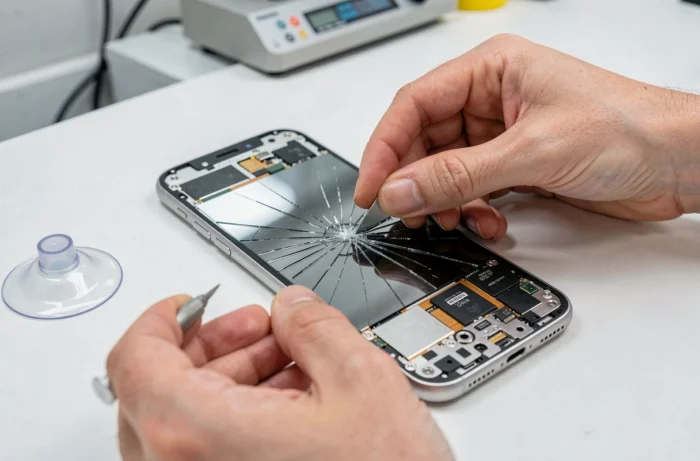
A replacement screen can be OEM, certified compatible, or generic. The difference lies in touch calibration, color fidelity, and adhesive durability. For batteries, the determining criterion is the certification of actual capacity in mAh, which guarantees that the delivered cell meets the announced specifications.
Online providers that label their parts as “premium” without specifying the origin or grade (OEM, certified aftermarket, generic) leave a gray area. We recommend prioritizing services that clearly display the type of part installed on the quote, and ideally on the invoice.
- OEM part (Original Equipment Manufacturer): made by the same supplier as the manufacturer. Compatibility and quality identical to the original.
- Certified aftermarket part: made by a third party but tested according to the manufacturer’s specifications. Good cost/reliability compromise.
- Generic part: no guaranteed compatibility certification. Low price, but risk of touch malfunction or accelerated battery degradation.
On a recent iPhone, the price difference between an OEM screen and a generic one may justify the extra cost, especially if the QualiRépar bonus applies. On a mid-range Android model, certified aftermarket offers the best quality/price ratio in most cases.
Data security when sending for repair
Entrusting a smartphone to a remote workshop involves physically sending a device containing all your personal data. Before sending, a complete backup (cloud or local) is a non-negotiable prerequisite. Disabling activation lock (Find My iPhone on iOS, Reset Protection on Android) is often required by the repairer to test the device after intervention.
If you cannot disable these protections (for example, if the screen is completely non-functional), inform the provider in advance. Some workshops have specific protocols for locked devices, but others will refuse the intervention to avoid any suspicion related to theft.
The handling of personal data during repair remains poorly regulated contractually by most online services. A professional provider will mention in their general conditions a confidentiality clause covering the data stored on the entrusted device.