
By replacing an oil boiler with an air-water heat pump, one can significantly reduce energy bills. However, the actual result depends on the existing insulation and the sizing of the installation. It is this gap between promise and reality that prompts a closer look at current trends in economical heating.
Wood pellets: a sector regaining momentum
On the ground, wood pellets are once again attracting households that, five years ago, would never have considered heating with wood. The reason lies less in the price of the fuel, which is already competitive per kilowatt-hour, than in the marked recovery of the pellet market in 2025 after a sharp slowdown the previous year.
Sales of pellet appliances (stoves and boilers) increased in 2025 according to Observ’ER, while log wood is declining. The persistent rise in fossil fuel prices reinforces the competitiveness gap in operation.
The other factor changing the game is user comfort. Unlike log wood, pellet appliances allow for hourly programming and power modulation. This brings it closer to the comfort of a conventional gas boiler, with a significantly lower fuel cost.
To follow the news on Mon Chauffage Économique, it is clear that this controllable aspect largely explains the widening audience reached by the pellet sector.

Heat pump: the market seeks its cruising speed
When sizing an air-water heat pump for a house from the 1980s with high-temperature radiators, the results can be disappointing if the installation is rushed. This scenario illustrates the current phase: the heat pump remains a technical pillar of the energy transition, but its commercial trajectory has changed.
After several years of very rapid growth, the market for individual heat pumps experienced a drop followed by stabilization. Air-water heat pumps perform better than air-air heat pumps in new builds, but the overall dynamic is no longer that of 2022-2023. Feedback varies on this point across segments.
The installation cost remains high, even with subsidies. Actual performance heavily depends on local climate and the quality of the installation. An installer who under-sizes the system or neglects the buffer tank can turn a high-performing heat pump into an electrical drain on very cold days.
Regulation 2026-2027: what changes concretely
Hybrid heat pumps with fossil fuel backup will be excluded from MaPrimeRénov’ starting September 1, 2026. This decision, reported by Selectra, alters the economic calculation for homeowners considering a mixed gas-heat pump solution.
In new builds, environmental regulations are pushing towards fully decarbonized solutions. Regarding energy performance certificates (DPE), an August 2026 decree prepares for the introduction of an A0 label for zero-emission buildings, applicable from 2027.
Gas boiler: anticipating replacement based on housing
The gas boiler remains the most common system in the existing stock. The regulatory trajectory is known: prohibition in new constructions, and mandatory replacement in the most energy-intensive homes by 2030.
For a homeowner whose gas boiler is still functioning, the question is not about changing it tomorrow. It is about anticipating the moment when maintenance will cost more than replacement and choosing the right alternative based on the housing configuration.
- Well-insulated individual house with existing hot water circuit: the air-water heat pump remains the most logical choice, provided it is installed by an RGE installer who properly sizes the system.
- Old poorly insulated housing: invest first in insulation before changing the heating system, or risk oversizing the equipment and never recouping the investment.
- House in a rural area with storage space: the pellet boiler offers one of the lowest operating costs on the market, with comfort comparable to gas due to automatic feeding.
- Apartment in a co-ownership: options are more constrained. Efficient electric heating (inertia radiators, next-generation radiant panels) can be a reasonable compromise if insulation is adequate.
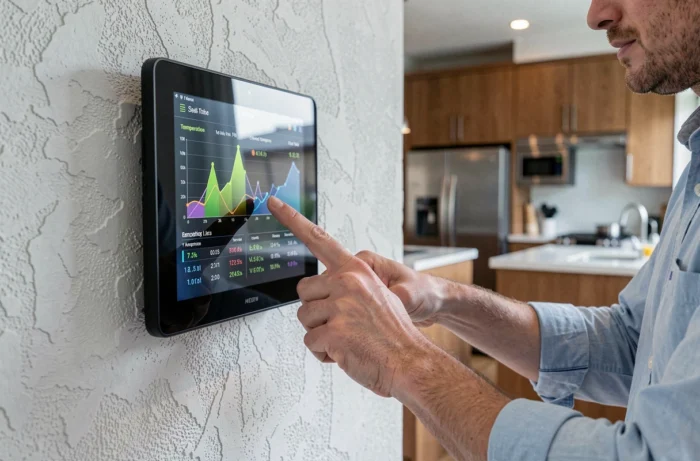
Connected thermostat and smart control: the real gain
Before replacing equipment, one can act on regulation. The connected thermostat remains the most accessible and cost-effective lever to reduce consumption without touching the boiler or heat pump.
A programmable thermostat that adjusts the temperature room by room, according to presence hours, significantly reduces the energy bill. The return on investment is measured in months.
More advanced systems integrate occupancy sensors, weather forecasts, and learning of household habits. The additional gain compared to a standard programmable thermostat exists, but it is more modest. For an average home, the priority remains to move from manual settings to automated control, even basic.
Predictive maintenance: an emerging focus
Some manufacturers offer maintenance alerts based on operational data analysis. A pellet boiler that signals a clogging before a breakdown, a heat pump that detects a drop in efficiency related to the refrigerant: these functions prevent emergency interventions and extend the lifespan of the equipment.
Households that achieve the best results in 2026 combine three levers: equipment suited to the housing, proper insulation, and automated consumption control.