
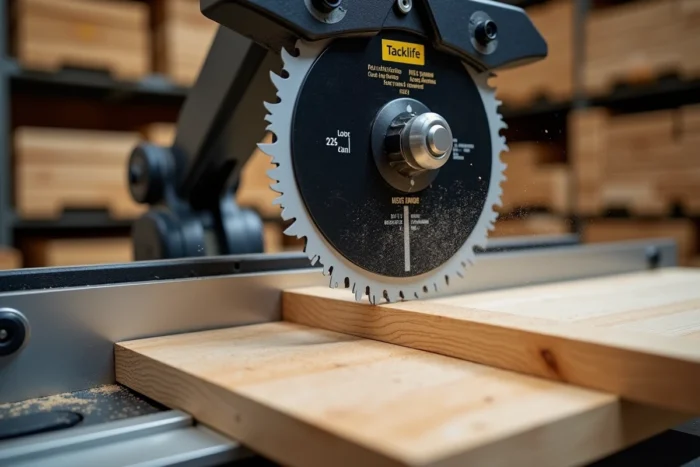
The Tacklife PMS03A is a radial miter saw positioned in the entry-level segment. It features a 305 mm blade and a sliding radial cutting function. On paper, these specifications place it alongside much more expensive models. The question that often arises in forums is less about raw power and more about the stability of the settings and the consistency of cuts after several hours of use.
Guidance and stability of the frame: what determines actual precision
On a radial saw, cutting precision depends more on the rigidity of the frame and the quality of the slides than on motor power. A powerful motor with a carriage that has lateral play produces uneven cuts, regardless of the speed.
The PMS03A uses a cylindrical rail system for radial movement. Initial user feedback indicates acceptable guidance right out of the box, but a tendency for mechanical play appears after regular use. This phenomenon is not unique to Tacklife: most entry-level radial saws share this fragility in guidance over time.
For those who want to delve deeper into the issue before purchasing, a detailed review of the Tacklife PMS03A allows for a comparison of manufacturer specifications with real-world feedback.
The rotating table for miter cuts relies on a pin locking mechanism with predefined positions. The 45° stop holds well, but intermediate angles require systematic checking with a square before each series of cuts. This control ritual is a constraint to consider if the machine is intended for finishing work (baseboards, frames, corner moldings).
Cut repeatability on the Tacklife PMS03A: the true test of reliability
A criterion rarely addressed in product sheets is repeatability, meaning the machine’s ability to reproduce exactly the same cut from one piece to another. On a professional saw, the difference between two identical cuts is measured in tenths of a millimeter. On an entry-level model, this difference can reach a millimeter or more.
With the PMS03A, repeatability remains acceptable over the first several dozen cuts at 90°. Results degrade more quickly on compound miter cuts (combined tilt and rotation), where the accumulation of mechanical play becomes noticeable.
The influence of the original blade
The blade supplied with the machine is a determining factor. Blades provided with entry-level saws are often made of brazed carbide with a limited number of teeth. Replacing the original blade with a fine-toothed blade significantly improves cut quality, sometimes more than any mechanical adjustment.
On the PMS03A, blade replacement is standard (bore compatible with most 305 mm blades on the market). This is a positive point: some competing models in the same price range use proprietary bores that limit options.
Durability and Tacklife after-sales service: a point to anticipate
User feedback on Tacklife tools, across all categories, describes a recurring pattern: acceptable performance upon unboxing, but more questionable reliability over time. The most frequently mentioned issues are premature wear of plastic parts (stops, blade guards, locking handles) and difficulty obtaining spare parts.
The brand’s after-sales service primarily operates through standard exchanges via online sales platforms. For an occasional DIYer using the machine a few weekends a year, this approach may be sufficient. For more sustained use (complete renovations, regular work), the risk of machine downtime is real.
- Wear parts (motor brushes, blade, guide) are easily found on the generic market, which partially compensates for the lack of dedicated after-sales service.
- Structural elements (rails, table, casing) are not sold separately by Tacklife, making any heavy repair impossible.
- The manufacturer’s warranty covers manufacturing defects but rarely mechanical wear related to intensive use.
Cutting capacity and types of work suitable for this radial saw
The 305 mm blade combined with the radial stroke allows for cutting relatively wide pieces. The cross-cutting capacity is one of the strong arguments for this model compared to non-radial miter saws sold at the same price.
In practice, the machine is well-suited for cutting battens, MDF baseboards, paneling, and parquet boards. It reaches its limits on thick hardwoods (solid oak beyond a certain section) where the motor shows signs of strain and the rotation speed drops significantly.
What the PMS03A does not replace
This saw does not replace a table saw for longitudinal cuts, nor a plunge saw on a rail for panel cuts. Its area of relevance remains short cross-cutting and miter cuts on small to medium section pieces. Expecting more would be outside its design scope.
- Cross-cutting of battens and common section rafters: suitable.
- Miter cuts on baseboards and moldings: suitable, with systematic angle verification.
- Cutting of thick hardwoods or abrasive composite materials: not recommended for repeated use.
For a DIYer looking for a versatile radial saw at a controlled cost, the Tacklife PMS03A fulfills its role on occasional jobs. Its main limitation is not power but mechanical consistency over time. The budget saved at purchase is wisely reinvested in a quality blade and regular maintenance of the slides.