
An electric hedge trimmer remains the most underestimated machine in the segment. Its constant power, low acquisition cost, and lack of engine maintenance make it a formidable tool for those who accept the constraint of the cable. We will detail the technical points that separate a relevant purchase from a poor investment, starting with a rarely addressed angle: the power supply itself.
Cable section and extension: the real bottleneck of a wired hedge trimmer
The majority of performance drops in an electric hedge trimmer do not come from the motor. They come from the extension cord. An undersized extension cable throttles the actual power of the machine, sometimes dramatically. The phenomenon is simple: the longer and thinner the extension, the greater the voltage drop. The motor runs, but it only delivers a fraction of its rated capacity.
We recommend never going below a section of 1.5 mm² for lengths up to 25 meters, and switching to 2.5 mm² beyond that. A non-unwound reel exacerbates the problem by overheating the cable coiled on itself. This point, absent from most buying guides, alone explains many negative reviews wrongly attributed to otherwise correct models.
Before blaming the power of your device, check the entire power supply chain. The resources available on taille-haie-electrique.com allow you to compare the characteristics of wired models and cross-reference this data with your garden configuration.
Tooth spacing and blade type: choose according to branch diameter
The spacing of the teeth (or cutting pitch) determines the maximum branch diameter that the blade can cleanly cut. This is the most discriminating technical criterion, far more than the raw power of the motor.

A tight cutting pitch is suitable for young leafy hedges, such as privet or boxwood, with fine branches. A wider spacing is necessary for country hedges or species like cherry laurel, whose woody branches thicken quickly.
- Regular maintenance hedges (fine branches, regular growth): a reduced spacing offers a clean cut without tearing the bark, limiting entry points for fungal diseases.
- Dense or mixed hedges (hornbeam, beech, photinia): an intermediate spacing accommodates thicker branches without straining the motor, reducing overheating.
- Hedges in recovery (severe pruning after several seasons without maintenance): a wide spacing is mandatory, and in some cases, a heavy-duty pruner or lopper is preferable to the hedge trimmer for the thickest wood.
Forcing a branch that is too thick into an unsuitable cutting pitch damages the blades and the drive mechanism. This action, common among hurried users, significantly shortens the tool’s lifespan.
Hedge trimmer blade length: the weight-efficiency compromise
A long blade covers more surface area with each pass and speeds up work on straight hedges. In return, it adds weight to the device and makes it less maneuverable in corners, curves, or topiary shapes.
For a garden with linear hedges of medium height, a blade of about 50 to 60 cm offers the best compromise. Below that, the number of passes increases and fatigue accumulates. Beyond that, the extra weight of the blade degrades cutting precision at height, especially with arms extended.
Double-blade models (both blades move in opposition) produce less vibration than a single blade with a fixed counter-blade. This detail, rarely highlighted, directly influences comfort during sessions longer than twenty minutes.
Working at height and pole hedge trimmer
For hedges over two meters, an electric pole hedge trimmer eliminates the need for a stepladder. The adjustable head allows you to tackle the top of the hedge without lifting the device above shoulder height. Ensure that the tilt system locks in multiple positions, not just two or three fixed angles.
Preventive maintenance: resin, ventilation, and blade sharpening
Clogging is the primary cause of overheating in an electric hedge trimmer. Cleaning the blades and ventilation grills after each session extends the lifespan by several seasons.
Vegetable resin, especially from conifers and laurel, forms a sticky deposit that hinders blade movement and increases the load on the motor. A cloth soaked in alcohol or a dedicated resin product is sufficient after each use. This task takes less than five minutes.
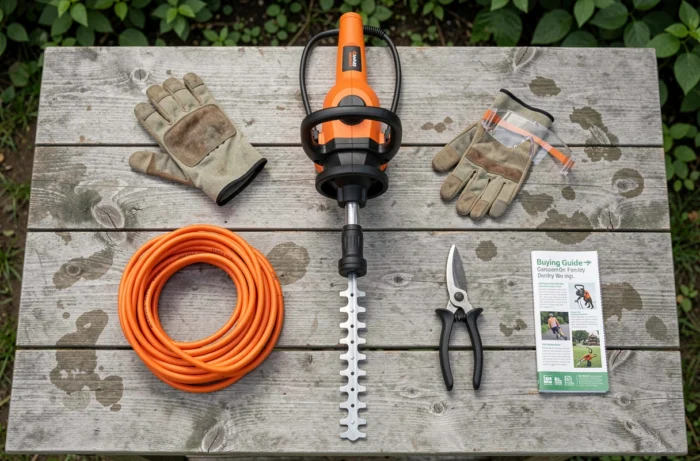
The ventilation grills, often located on the motor housing, become clogged with plant debris sucked in during cutting. A dry brush or a blast of compressed air effectively clears them. Ignoring this point causes a temperature rise that irreversibly degrades the motor windings.
- After each use: wipe the blades, remove resin, check the ventilation grills.
- Every three to four uses: lubricate the blades with an appropriate spray (no thick grease that collects debris).
- Once per season: check the sharpness of the teeth and sharpen if necessary with a fine flat file, respecting the original angle.
A well-maintained hedge trimmer cuts faster and consumes less energy than a new model clogged after three uses without cleaning.
Motor power of an electric hedge trimmer: what watts don’t tell you
The power displayed in watts gives an indication of the machine’s potential, not its actual efficiency. Two motors of identical power can offer very different performances depending on the quality of the transmission, the type of blade, and the design of the housing.
We regularly observe that moderately powered models, equipped with well-designed blades and a good reduction system, outperform more powerful but poorly optimized devices. Power remains a useful pre-selection criterion to eliminate entry-level models that are too weak, but it should not be the deciding factor.
The total weight of the device, the quality of the rotating handle (when it exists), and the overall balance matter more for regular use than a few extra watts.
A well-chosen electric hedge trimmer, powered by a properly sized extension cord and maintained after each session, meets the needs of the vast majority of private gardens. The most common mistake remains over-sizing the machine instead of checking the compatibility between the cutting pitch and the type of hedge to be trimmed.