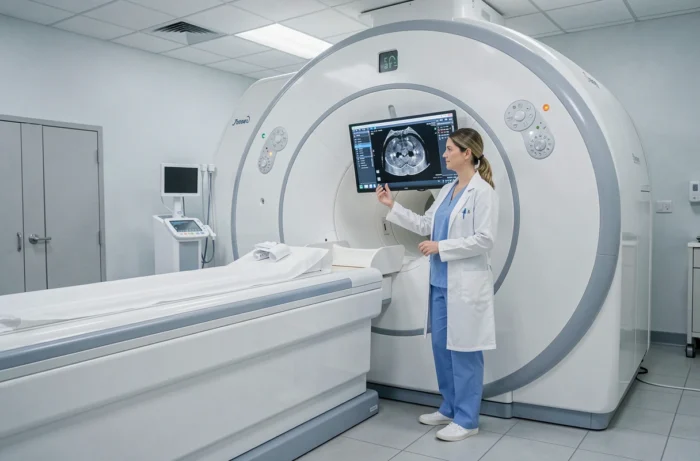
The price of a pelvic MRI in a hospital depends on variables that standard guides do not always detail: the radiologist’s contracting sector, the technical fee of the establishment, and especially the recently increased flat-rate contribution. Understanding these components allows for anticipating the actual out-of-pocket expenses even before making an appointment.
Technical fee and medical fees: two distinct billing lines
The bill for a pelvic MRI is not limited to a single price. It breaks down into two items that Health Insurance treats separately: the technical fee, paid to the establishment operating the machine, and the fees of the radiologist who performs and interprets the examination.
The technical fee covers the depreciation of the device, maintenance, and operation of the technical platform. Its amount is set by the nomenclature (CCAM) and varies according to the power of the magnet and the complexity of the acquisition. Medical fees, on the other hand, depend on the contracting sector of the practitioner.
A sector 1 contracted radiologist applies the base rate of Social Security without exceeding it. In sector 2, fee overruns are possible, even if the practitioner adheres to the OPTAM (Controlled Pricing Practice Option), a system that regulates these overruns in exchange for better reimbursement for the patient. To anticipate the cost of a pelvic MRI in a specific hospital, it is therefore necessary to check both the displayed technical fee and the sector of the radiologist who will be working that day.
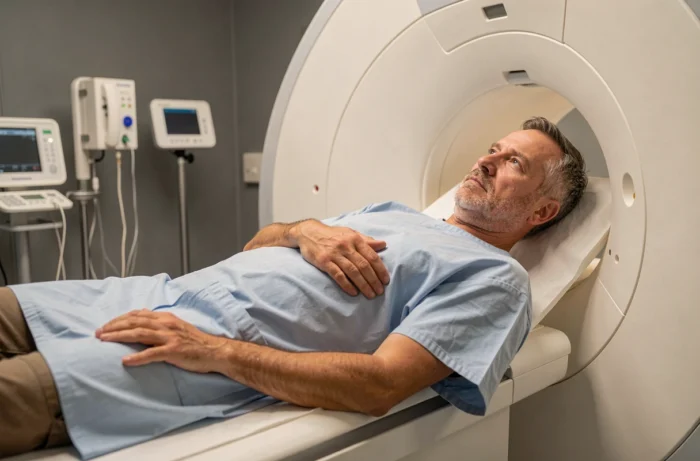
Base rates for a pelvic MRI according to the radiologist’s sector
The table below summarizes the billing discrepancies based on the practitioner’s profile. The base amounts correspond to the conventional pricing of Health Insurance for a standard pelvic MRI.
| Criterion | Sector 1 | Sector 2 (without OPTAM) | Sector 2 (OPTAM) |
|---|---|---|---|
| Fee overruns | None | Free (tact and measure) | Regulated |
| Social Security reimbursement (base) | 70% of the conventional rate | 70% of the conventional rate | 70% of the conventional rate |
| Out-of-pocket expenses before mutual insurance | Only the co-payment | Co-payment + full overrun | Co-payment + partial overrun |
| Mutual coverage of the overrun | Not applicable | Variable depending on the contract | Often better covered |
The sector of the radiologist determines most of the price difference between two pelvic MRIs performed on comparable equipment. In public hospitals, the majority of practitioners work in sector 1. In private clinics attached to a hospital platform, sector 2 is more common.
Flat-rate contribution and deductibles: the invisible out-of-pocket expenses
Since 2024, the flat-rate contribution on radiological procedures has increased from 1 euro to 2 euros per procedure. This doubling, applied to all consultations and examinations, modifies the calculation of the total out-of-pocket expenses for a pelvic MRI.
The flat-rate contribution is capped at 8 euros per day and 50 euros per year. If the pelvic MRI is performed on the same day as a follow-up consultation and another imaging procedure, the total can quickly reach this daily cap. This mechanism often goes unnoticed because it does not appear on the initial estimate of the examination.
In practice, a patient who undergoes a specialized consultation, pelvic MRI, and injection of contrast agent on the same day will incur several flat-rate contributions. The unit amount remains modest, but the annual total can add up, especially for patients under regular follow-up (chronic pelvic pathologies, oncology protocols).
What mutual insurance covers (or does not) regarding these deductibles
Most mutual insurance contracts do not reimburse flat-rate contributions or medical deductibles. This exclusion is legal and applies to both entry-level contracts and the majority of intermediate plans. Only certain contracts labeled “supplementary” cover this item, and even then, only partially.
- The co-payment (30% remaining after Social Security reimbursement) is covered by almost all health mutuals, including responsible contracts.
- Fee overruns are reimbursed according to the level of coverage: 100%, 200%, or 300% of the conventional rate depending on the subscribed contract.
- Flat-rate contributions (2 euros per procedure since 2024) remain the patient’s responsibility in the vast majority of cases, regardless of the contract level.
Pelvic MRI with or without injection: impact on the final price
The injection of a contrast agent (gadolinium) is frequently required for a pelvic MRI, particularly in the assessment of tumor spread or the exploration of complex endometriosis pathologies. This injection adds an additional procedure to the billing.
The injection of contrast agent generates an additional charge billed on top of the technical fee and interpretation fees. This additional charge is also subject to the flat-rate contribution of 2 euros, which brings the number of contributions to at least two for the MRI session alone.
The radiologist decides on the injection after the first acquisition sequences. It can therefore happen that the initial estimate does not mention it, and the patient discovers the additional cost afterward. Asking in advance if the injection is likely, depending on the clinical indication, helps anticipate the bill.

Prescription and care pathway: two conditions for optimal reimbursement
A pelvic MRI performed without a prescription or outside the coordinated care pathway incurs a reimbursement penalty. Health Insurance then applies a reduced rate, and the out-of-pocket expenses increase significantly.
- The prescription must be written by the attending physician or by a specialist as part of a referral (coordinated care pathway).
- Failure to comply with the care pathway can lower the reimbursement rate from Social Security, mechanically increasing the remaining share.
- Not declaring an attending physician to Social Security also incurs a financial penalty, independent of the radiologist’s sector.
Checking these two points before making an appointment remains the simplest lever to limit out-of-pocket expenses. A respected care pathway and a sector 1 radiologist bring the actual cost down to just the co-payment, to which are added the non-reimbursable flat-rate contributions.
The cost of a pelvic MRI in the hospital is less about the displayed rate than about the accumulation of small peripheral items: doubled flat-rate contribution, unanticipated injection, overrun in sector 2. The most useful data before any appointment remains the radiologist’s contracting sector, the only variable that truly shifts the bill.