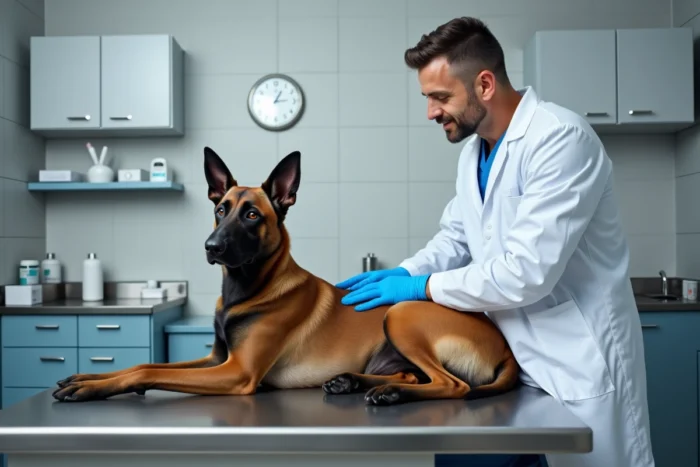
Your Malinois is six months, one year, maybe two years old, and the question comes up at every visit to the vet: should you sterilize him, and if so, when? For this large, athletic breed often used for work, the answer is not a simple yes or no. Sterilizing a Malinois involves choices that affect his joint health, metabolism, and daily behavior.
Sterilization of the Malinois and orthopedic risks: the often underestimated factor
In large breeds like the Malinois, early sterilization increases the risk of joint injuries. Sex hormones play a direct role in the closure of growth plates.
When these hormones are removed before the end of bone growth, the bones continue to grow slightly longer. The result: altered joint proportions, an increased predisposition to cruciate ligament tears, and dysplasia. For an active dog like the Malinois, this is a real problem that can limit his mobility in the long term.
Veterinarians specializing in working dogs recommend waiting until growth is complete before considering the procedure. For a Malinois, this generally means after full puberty. Understanding the advantages and disadvantages of sterilizing a Malinois starts with this joint data, which is still rarely discussed during routine consultations.

Prevention of tumors and pyometra in female Malinois
For females, sterilization offers documented medical benefits. Removing the ovaries eliminates the risk of ovarian tumors and significantly reduces the risk of mammary tumors, provided the procedure is performed early in the dog’s life.
Pyometra, a serious infection of the uterus, also disappears from the risk profile after an ovariectomy. This disease can endanger the animal’s life and often requires emergency surgery. Planned sterilization, performed under good conditions, remains much less risky than an emergency procedure on an infected uterus.
What sterilization changes in daily life for a female
No more heat cycles, no more blood loss, no more males lurking around the house or garden. For owners who do not plan to breed, this practical comfort weighs in on the decision. The dog’s behavior also stabilizes: mood swings related to hormonal cycles fade away.
Behavior of the Malinois after castration: what really changes
Castration does not change a Malinois’s temperament. Castration does not correct a training issue or a lack of physical exercise. An untrained Malinois will remain difficult to manage, whether he is neutered or not.
What may evolve is the behavior directly related to sex hormones: excessive urination marking, the tendency to run away to join a female in heat, certain forms of aggression between males. These behaviors often decrease after castration, but not systematically.
For working or sport Malinois, the question is approached differently. Field reports indicate that castration may reduce motivation and intensity at work in some individuals. Organizations that employ Malinois for detection or intervention often prefer a case-by-case approach, in consultation with a specialized veterinarian.
Weight gain and muscle management in neutered Malinois
After sterilization, the Malinois’s metabolism slows down. The dog burns fewer calories at rest, and his appetite may increase. If the diet is not adjusted, weight gain can occur within a few months.
In a large dog, every extra kilo has direct repercussions on the joints. The cascade is well-known among veterinarians:
- Progressive weight gain related to decreased post-sterilization metabolism
- Mechanical overload on the hips and knees, areas already sensitive in large breeds
- Increased risk of osteoarthritis and ligament injuries in the medium term
Switching to a specific diet for neutered dogs is part of standard recommendations. Regular monitoring of body condition and a structured exercise program complement this prevention. The Malinois needs to maintain his muscle mass to protect his joints.
Sterilization of the Malinois: adoption, work, or companionship, different logics
The dog’s living context radically changes the analysis. Several adoption organizations now require the sterilization of Malinois placed in families to limit uncontrolled breeding and abandonment. This policy is justified: the Malinois is one of the most represented breeds in shelters, often due to poorly prepared adoptions.
For a working Malinois followed by a specialized veterinarian, the approach is more nuanced. The decision is made based on the dog’s mission, health status, and age. Some professionals opt for temporary chemical sterilization before deciding on a permanent procedure.
Criteria to evaluate before making the decision
- The dog’s age and the state of advancement of his bone growth
- His daily activity: family companion, canine sport, professional work
- The health history of his lineage, particularly regarding joints
- The owner’s ability to manage heat cycles or the behavior of an intact male
Sterilization is neither mandatory nor universally beneficial. It remains a medical act whose benefit-risk ratio varies for each Malinois. The best decision is made with a veterinarian who knows the breed and your dog’s history, not based on a general opinion.