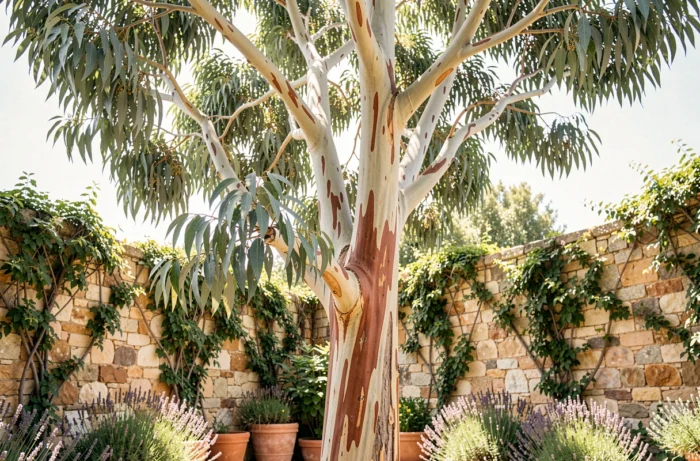
Lemon eucalyptus (Corymbia citriodora, formerly Eucalyptus citriodora) is the only tree of the genus whose repellent potential is based on solid data. Its leaves produce p-menthane-3,8-diol (PMD), a compound recognized as a repellent by British health authorities and classified as an insecticide in European regulatory databases. Confusing the living tree with the formulated product based on its essential oil remains the most common mistake in popular articles.
PMD and essential oil of lemon eucalyptus: two distinct realities
PMD is obtained through hydrodistillation and then acid conversion of the aldehydes contained in the leaves of Corymbia citriodora. At equivalent concentrations, DEET slightly outperforms PMD, but the latter is still considered a true repellent as long as it is properly formulated and reapplied frequently, according to recommendations from the UK Health Security Agency (UKMEAG, updated July 2026).
A lemon eucalyptus planted in the ground in a garden in southern France does not spontaneously release PMD into the ambient air at concentrations sufficient to create a barrier. The potted or mass-planted tree does not provide detectable spatial repulsion under real conditions.
A field study published via PubMed Central showed that no plant-based treatment, even when crushed to release more volatile compounds, significantly reduced mosquito captures compared to a control without repellent.
For those wishing to delve deeper into the subject, anti-mosquito eucalyptus shrubs and trees deserve careful consideration before any nursery purchase. The distinction between cosmetic effect and real protection conditions the landscaping strategy.
Eucalyptus in the garden: hardiness, pruning, and cultural constraints
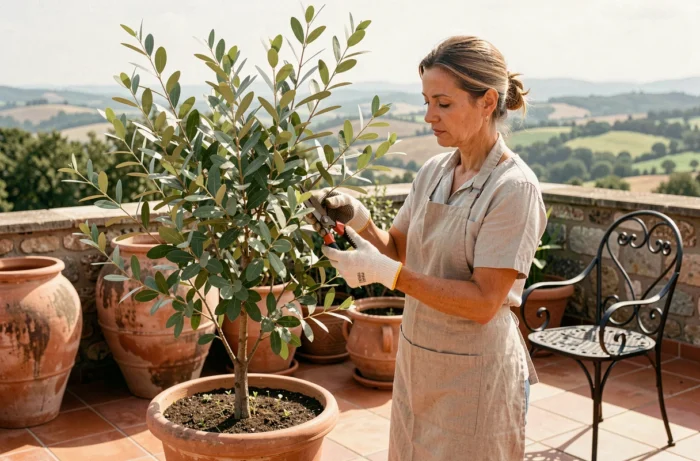
Corymbia citriodora does not tolerate prolonged frosts below -3 °C well. In the Mediterranean zone and on the southern Atlantic coast, it can reach tree size in just a few years. Elsewhere, we recommend container cultivation with frost-free wintering, which mechanically limits leaf surface area and thus the amount of volatile compounds emitted.
Eucalyptus gunnii and other ornamental species
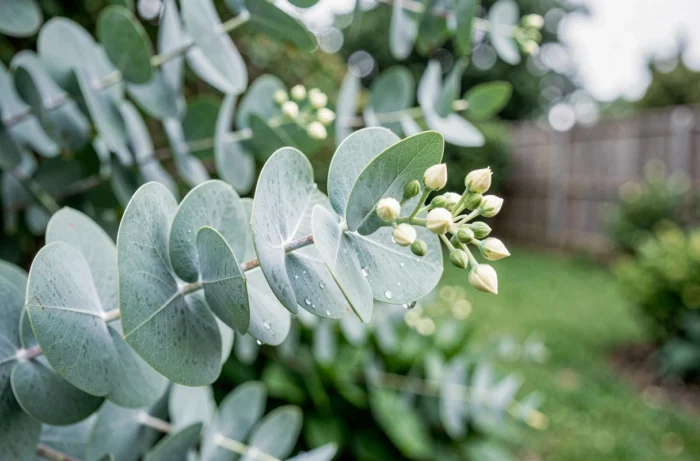
Eucalyptus gunnii, often sold in garden centers as “hardy eucalyptus,” withstands significantly lower temperatures. Its foliage emits a pleasant camphor scent, but it does not contain PMD in significant quantities. Its value is ornamental, not repellent. The same observation applies to Eucalyptus pauciflora or E. dalrympleana: their terpene profile differs radically from that of lemon eucalyptus.
The common mistake is to buy an ornamental eucalyptus thinking it will provide an anti-mosquito effect. Nurserymen exploit the confusion between species. Only Corymbia citriodora has a documented chemical profile in this regard.
Spatial repulsion in the garden: what studies really measure
The field study mentioned earlier compared ornamental plants reputed to be repellent (including crushed aromatics) to a device based on metofluthrin. The result: the chemical device significantly reduced mosquito captures, while the plants had no statistically measurable effect.
We regularly observe this disappointment among gardeners who create “anti-mosquito” beds combining lavender, lemongrass, and eucalyptus. The scent perceived by humans does not correspond to a concentration sufficient to affect insect behavior in an open space. The dispersion of volatile compounds outdoors makes any perimeter protection illusory by mere plant presence.
Management of stagnant water: the truly effective lever
A female mosquito lays eggs in just a few centiliters of stagnant water. Eliminating these reservoirs (saucers, clogged gutters, tarps, storm drains) produces a measurable effect on the local population, unlike any planting. The tiger mosquito, now present in the vast majority of French departments, reproduces within a very short radius around its breeding site.
- Empty or turn over any container that can collect rainwater, including garden toys and hollow parasol bases
- Cover water reserves (water collectors, barrels) with mesh smaller than a millimeter to prevent laying
- Maintain gutters and check the drainage of raised terraces, where water often stagnates without being visible
- Treat incompressible water points (ornamental pond) with a biological larvicide based on Bacillus thuringiensis israelensis (Bti)
Combining lemon eucalyptus and integrated mosquito management strategy
Planting a Corymbia citriodora is not absurd if one accepts that it will not replace either a skin repellent or the elimination of larval breeding sites. Its crushed foliage can serve as raw material for maceration or occasional use on the skin, provided precautions related to essential oils are observed (photosensitization, contraindications in young children).
The most effective strategy combines the elimination of stagnant water, formulated body repellent, and, possibly, a spatial device based on pyrethroids. Lemon eucalyptus fits into a garden as a beautiful tree with an upright habit, fragrant foliage, and decorative bark. Assigning it a role as an anti-mosquito shield exceeds what science validates.
A “calm” garden regarding mosquitoes is primarily built through rigorous water management and the choice of repellents whose effectiveness is measured. Lemon eucalyptus finds its place as an ornamental tree, not as a standalone solution.