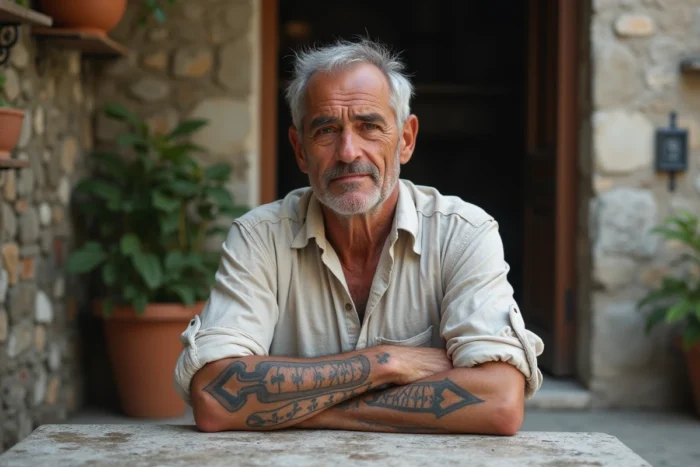
A tattoo design on the forearm, seen on a beach in Porto-Vecchio or in the streets of Ajaccio, often tells much more than just an aesthetic choice. Corsican tattoos draw from a repertoire of ancient symbols, linked to the island’s history, its struggles, and its collective identity. Understanding these motifs is like reading a condensed version of island culture on the skin.
What French regulations impose on tattoo studios in Corsica
Before discussing symbols, a lesser-known detail deserves your attention. Have you ever noticed the yellow bins in a tattoo studio? They are not a decorative accessory.
The ARS Provence-Alpes-Côte d’Azur classifies waste from tattooing activities involving skin penetration as infectious risk healthcare waste. Specifically, used needles, soiled gloves, and residual inks follow the same disposal process as waste from cosmetic surgery or veterinary medicine.
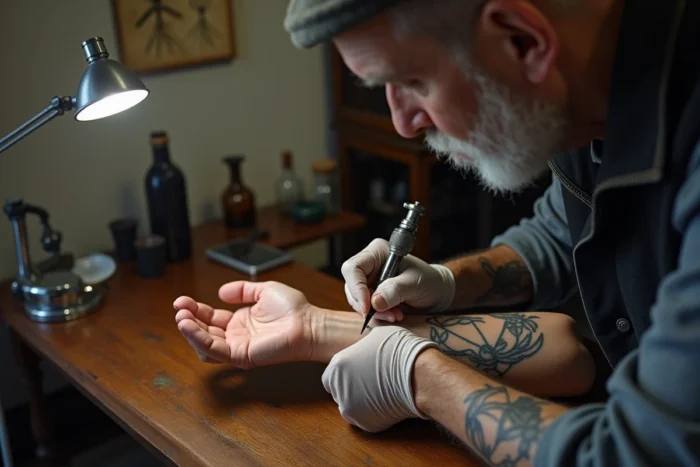
For Corsican studios, this means mandatory contracts with approved waste collection providers, a traceability register, and regular health inspections. This requirement contributes to the professionalization of the trade on the island, where supervised internships with practical training on models have been multiplying in recent years. One better understands the meaning of Corsican tattoos when considering the seriousness of the framework in which they are now created.
Head of Maure tattooed: symbol of the Corsican flag on the skin
The most requested design remains, unsurprisingly, the head of Maure. This profile face, adorned with a white headband, has appeared on the Corsican flag for centuries. But why tattoo it instead of simply displaying it?
For many wearers, engraving this emblem into the skin goes beyond patriotism. The tattooed head of Maure asserts a belonging that cannot be removed. It signifies rootedness, loyalty to a land and a family history.
The headband raised on the forehead is significant. In older versions, it covered the eyes. Its repositioning symbolizes emancipation and regained freedom. A tattoo artist who understands this nuance will propose a placement of the headband that aligns with the intended message.
Common graphic variations
The design comes in several forms depending on the tattoo artist’s style and the client’s preferences:
- Realistic version with detailed shading, often placed on the calf or shoulder, that faithfully reproduces the official emblem
- Geometric or minimalist version, reduced to a few clean lines, popular on the wrist or behind the ear
- Version integrated into a larger composition, associated with the map of the island, the maquis, or marine elements
Map of the island and maquis: Corsican tattoos linked to the territory
The silhouette of Corsica, recognizable among all, constitutes another recurring motif. Tattooed alone or combined with other elements, it functions as a geographical signature.
The tattooed map of the island serves as an identity anchor, especially for Corsicans living on the mainland or abroad. It materializes a connection to the place of origin that distance cannot erase.
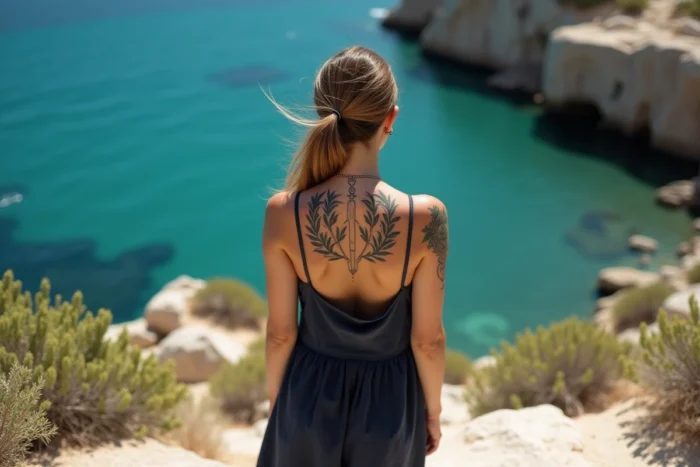
The maquis, this dense and fragrant vegetation covering the island’s mountains, also inspires tattoo artists. Olive branches, cistus flowers, strawberry tree leaves: these botanical elements express an attachment to the Corsican landscape as much as to its culture. Each plant of the maquis carries a specific symbol in island tradition. The immortelle, for example, evokes memory and resistance.
Religious symbols and Corsican mottos in tattooing
Corsica maintains a close relationship with the sacred. Crosses, representations of patron saints, and prayers engraved in the Corsican language frequently appear in island tattoos.
Saint Devote, patroness of Corsica and Monaco, is sometimes stylized in tattoos, accompanied by the boat that recalls her legend. These motifs are not merely religious decoration. They inscribe the wearer in a spiritual and community lineage.
The mottos and phrases in the Corsican language
The Corsican language itself becomes material for tattoos. A few examples of engraved phrases:
- “Dio vi salvi Regina”, a Corsican hymn of religious origin, tattooed in classic or gothic lettering
- “A casa hè indè u core hè”, which can be translated as “home is where the heart is”, a frequent choice among expatriates
- Proverbs or names of villages in handwritten script, to anchor the tattoo in a specific place
The choice of typography is not trivial. An ancient calligraphic lettering evokes tradition, while a sober, modern font gives the same text a more contemporary reading.
Choosing a Corsican tattoo: substance before form
Before selecting a design, the question to ask is not “which design is beautiful” but “which symbol resonates with me.” A successful Corsican tattoo relies on the coherence between the wearer’s experience and the meaning of the motif.
A non-Corsican wishing to get a tattoo of the head of Maure or the map of the island benefits from discussing with a tattoo artist familiar with the local culture. Respect for the symbol is as important as the quality of the line. Some motifs carry a strong historical weight, and wearing them without understanding their significance can create misunderstandings.
The professionalization of studios in Corsica facilitates this dialogue. Tattoo artists trained in structured internships master both the technique and the cultural context of the motifs they offer. Corsican tattooing, far from being frozen in the past, continues to evolve with each person who chooses to wear a fragment of the island on their skin.